
Author name: CMEA_YaYa

Why Your Chinese Property Leads Do Not Convert
China Marketing 101

Why Your Chinese Property Leads Do Not Convert?

Introduction: Conversion Problems Do Not Necessarily Come from Poor Lead Quality Many Dubai real estate companies expect Chinese investors to provide a complete picture of their budget, purchase timeline, and personal circumstances as soon as they see a project, price, and payment plan. In reality, the process is often more complex. Chinese buyers may be willing to send a direct message, submit an enquiry, add a sales representative on WeChat, or leave their contact details, but they are often cautious during the first conversation and reluctant to immediately disclose their actual budget, purchase timeline, or financial situation. This caution does not mean they lack purchase intent or buying power. Buyers may also be evaluating whether the project is reliable, whether the company can be trusted, and whether the sales representative can provide professional, accurate, and consistent information before deciding how much sensitive information to disclose. Many Dubai real estate companies interpret the longer decision cycle of Chinese buyers as a lack of purchase intent. In reality, Chinese buyers do not necessarily lack intent; they build trust, verify information, and express interest differently. Businesses need to adapt traditional lead qualification methods and align their information with sales follow-up. Why Inconsistent Information Weakens Conversion Information gaps weaken trust. During the decision-making process, Chinese buyers usually verify the following questions repeatedly: • What makes up the total cost and fees? In addition to registration fees published by the Dubai Land Department, different projects may involve brokerage, service, financing, or other project-related costs. Businesses should explain each item and remind buyers to refer to the latest official information and the specific contract. • What are the developer’s and the project’s delivery records? Buyers want verifiable historical records, current progress, expected handover arrangements, and a clear communication process if plans change. • How should rental demand, holding costs, and exit conditions be assessed? Marketing materials should distinguish between market data, modelling assumptions, and guaranteed outcomes, while clearly stating data sources and the conditions under which they apply. • What is the purchase and registration process for foreign buyers? Businesses should provide a clear explanation of the process and direct buyers to verify their circumstances through official Dubai channels and qualified legal, tax, or financial professionals. When different channels provide inconsistent answers, key costs are presented vaguely, or sales representatives cannot explain the project materials, buyer caution increases. Transparent, verifiable, and consistent information is the foundation of trust. Why Traditional Lead Qualification Can Misjudge Chinese Buyers Chinese buyers may enquire earlier than many Dubai sales teams expect, but they often disclose less information at the beginning. A buyer who declines to share an exact budget or purchase timeline is not necessarily unqualified. Before sharing sensitive financial details, they may still be evaluating the project, company, and sales representative. If the sales team assesses lead quality only by whether a client immediately states a budget, it may abandon genuine prospective buyers too early. A more suitable approach is to observe whether the client continues moving forward, for example: • Are their questions becoming increasingly specific? • Do they repeatedly view, save, or ask about the same area, developer, or project? • Are they willing to attend an online project presentation, book a viewing, or confirm the next conversation? • Do they request tailored materials? • Do they follow up on previously shared information or provide new clues about their requirements? Sales teams do not need to obtain all information during the first conversation. A more effective approach is to answer the question that matters most to the buyer at that moment, then use subsequent behaviour to assess the buyer’s stage and real needs gradually. Sales teams can first provide materials that reduce uncertainty, then use progressive questions to understand budget, timing, and objectives. Buyers enter the funnel at different stages, so the follow-up cadence should also differ: those in the early discovery stage need clear educational content; those comparing options need targeted materials; and buyers with defined objectives need fast, specific project responses. What High-Converting Dubai Property Companies Do Differently Dubai developers and real estate agencies that consistently serve Chinese buyers do not usually treat a single click, direct message, or response to the first budget question as the sole basis for judging lead quality. They assign different roles to content, Chinese-language information assets, and sales conversations, while ensuring that buyers receive consistent, verifiable information regardless of the channel through which they enter. The customer journey may involve multiple interactions over weeks or months, but buyers with clear objectives can also move quickly. The point is not to assume that every Chinese client requires a long sales cycle, but to identify whether they are currently in the discovery, comparison, or decision stage and follow up with content and sales methods suited to that stage. Conclusion: Evaluate Enquiries Through Behaviour and Trust, Not Just the First Answer When Chinese property leads do not convert, it is not always because the client lacks buying power or genuine intent. Inconsistent information, unanswered key questions, asking for sensitive information too early, and follow-up that does not match the client’s stage can all cause a promising buyer to stall in the funnel. A more effective approach is to reduce uncertainty through transparent materials, identify intent through sustained behaviour, and enable the sales team to follow up differently at the discovery, comparison, and decision stages. How CMEA Can Help • Lead Handling Guidance and Sales Localisation • RedNote and WeChat Customer Journey Planning • Chinese-Language Landing Pages and Information Assets • Performance Analysis Across Content, Search, and Enquiry Touchpoints Want to reduce drop-off among Chinese property enquiries and build a follow-up approach better suited to Chinese buyers? Contact CMEA now.
How to Improve Your Brand Visibility on Chinese AI Platforms
China Marketing 101

How to Improve Your Brand Visibility on Chinese AI Platforms?

Introduction: Why the Chinese Market Requires a Separate AI Visibility Strategy For international brands, visibility within China’s AI ecosystem cannot simply be treated as an extension of global generative engine optimisation (GEO). China’s digital environment has different search infrastructure, Chinese-language content platforms, closed platform ecosystems and source networks. This means international brands cannot directly replicate a global GEO strategy. Even a brand with a well-established global digital presence may still be difficult for Chinese AI platforms to discover, understand or verify. In this context, AI visibility usually appears at three levels: Mentioned. The brand name appears directly in an AI-generated answer. Cited. The answer cites the brand’s official website or another credible source, allowing users to review and verify the information. Compared or recommended. The brand appears alongside other options and is compared using verifiable information such as services, locations, credentials or relevant advantages. Moving from a basic mention to being included in a comparison or recommendation requires more than isolated pieces of content. A brand’s core information needs to be accessible, clear and consistent, and supported across the different sources that Chinese users and AI platforms may encounter. Understanding the Information Ecosystems Behind Chinese AI Platforms At CMEA, we treat Chinese AI visibility as a distinct discipline within China digital strategy.Chinese AI platforms do not rely on a single, unified information system. Depending on the product, feature, query type and timing, an AI answer may combine pretrained knowledge, real-time web search, search indexes, official websites, media reports and content from the platform’s own ecosystem. This means source coverage is relatively fragmented. Official websites can provide authoritative core brand information; Chinese search supports discovery; and WeChat, Zhihu, Xiaohongshu, Douyin and industry media can add context, public discussion and third-party sources. The importance of each source is not fixed, and the same question may produce different answers in different tools. Doubao (ByteDance): Doubao primarily retrieves content from within ByteDance’s ecosystem, including Toutiao, Douyin and Xigua Video. According to data published by QuestMobile, for destination recommendations and travel-guide queries, Doubao cites Douyin content at a rate of up to 97.7% and Toutiao content at a rate of 84.5%, showing a distinct closed-ecosystem pattern. ERNIE Bot (Baidu): Built on Baidu Search data, with Baidu indexing and site authority directly affecting the likelihood that a source will be used. ERNIE Bot inherits Baidu’s traditional search authority system while adding semantic verification through large language models. Qwen (Alibaba): Qwen draws on a range of products within Alibaba’s ecosystem. Alibaba Cloud content, Amap POI information, UC Browser content feeds, Shenma Search webpage indexes and Tmall/Taobao e-commerce data together form its multidimensional source pool. Qwen generally follows an open-integration model that combines authoritative industry websites with content media. Tencent Yuanbao: Prioritises content from Tencent’s ecosystem, including WeChat Official Accounts, while also connecting to WeChat Search and Sogou Search. Yuanbao follows a more layered approach: it first draws on Tencent ecosystem content and then turns to external authoritative sources for deeper decision-making queries. DeepSeek: Supports internet search across publicly available webpages and prioritises well-structured, authoritative and traceable websites. According to a source-citation test conducted by the Zesen Technology team from March to May 2026, covering four major AI platforms and 16,800 real queries, DeepSeek showed a preference in technical queries for content from CSDN (24.6%), Zhihu (19.8%) and CNBlogs (15.3%). Brands should therefore avoid building their strategy around unverified assumptions that a particular AI platform always prefers one channel or content format. A more reliable approach is to establish a coordinated Chinese-language information system, enabling brand information to be discovered and cross-checked through multiple relevant pathways. A Strategic Framework for Building Brand Visibility Across China’s AI Ecosystem 1. Build an Accessible and Credible Chinese Digital Foundation Begin with a reliable official digital presence that users in China can access and that search and discovery systems can understand. Publish essential information in natural, professional Chinese, including the company name, brand positioning, products or services, locations, credentials and contact details. Important pages should use clear headings, concise summaries, FAQs and structured information. The goal is not to add technical complexity, but to establish a reliable official source that clearly explains who the brand is, what it offers and why the information is credible. 2. Establish a Presence Across Relevant Chinese Information Ecosystems Different channels should serve different communication roles. The official website should hold consistent and authoritative brand information; Chinese search helps users discover it; WeChat is suited to ongoing official communication; Zhihu supports professional explanations; Xiaohongshu connects lifestyle content with specific user scenarios; and relevant industry media provide independent context and third-party validation. Channel selection should be based on the target audience, industry and content purpose. 3. Strengthen Authority Through Consistent, Verifiable Information A brand becomes more authoritative when the same core facts can be corroborated across multiple credible sources. Keep the brand name, service descriptions, locations, credentials, case information and other important details consistent and up to date across the official website, platform accounts and media coverage. Important claims should be supported by evidence and clear context, while genuine third-party sources can provide independent verification. This gives users and AI systems more reliable information for comparison and cross-checking. 4. Monitor Visibility and Refine the Content Strategy Regularly test representative questions on the AI platforms most relevant to the brand’s audience. Record whether the brand is mentioned, how it is described, which sources are cited, whether any information is inaccurate or outdated, and how competing brands appear. Because answers may vary according to query wording, product mode and timing, each test should be treated as a snapshot. Use the findings to close information gaps, update priority pages and refine channel and content planning. CMEA provides international brands with an integrated China digital visibility solution by combining Chinese digital foundations, content localisation, channel planning, media relations and ongoing monitoring. CMEA helps brands align official information with third-party sources so that Chinese search engines, content platforms and AI systems can more easily discover, understand and cross-check the brand. This work

Chinese AI Is Becoming the New Gatekeeper of Consumer Decisions
China Marketing 101

Chinese AI Is Becoming the New Gatekeeper of Consumer Decisions

Introduction: 86% of Chinese Consumers Use AI Tools Weekly – and It Is Changing Everything The way Chinese consumers discover, evaluate, and choose brands is undergoing a fundamental transformation. According to an Accenture consumer survey, by January 2026, 86% of Chinese consumers were using AI tools at least once a week – far above the global average of approximately 57%; 37% of consumers were already using AI during the shopping process, mainly to understand unfamiliar categories and compare brands quickly.  For international brands targeting Chinese consumers, this is not a distant trend. It is already reshaping how customers discover, compare and shortlist businesses. OC&C research shows that AI tools have risen to become the fourth-largest decision-making channel for Chinese consumers, behind traditional e-commerce platforms and livestreaming platforms, influencing 37% of purchasing decisions. More importantly, consumer trust in recommendations from AI assistants has reached 21%, exceeding trust in celebrity endorsements (19%) for the first time. More importantly, over half of AI tool users say that AI has already replaced search engines as the way they access information. AI is not simply helping users search for information; it is shortlisting brands for them. The AI Revolution in Chinese Consumer Decision-Making ·From “Searching” to “Being Given the Answer” The traditional consumer decision funnel – “search box -> product matrix -> shopping cart” – is now being replaced by a new paradigm: “AI intent recognition -> personalised recommendation -> AI-assisted price comparison -> user confirmation”. Christine Wang, President of Accenture Song Greater China, put it precisely: “In the future, brands will need not only to appeal to consumers, but also to their AI assistants.” This means that when a Chinese traveller asks an AI assistant to recommend luxury hotels in Dubai, compare medical providers in Singapore, or evaluate universities in the UK. AI is not simply passing on information. It is curating, filtering, and recommending whose links should rank higher. In effect, it acts as a gatekeeper between brands and consumers. The Four AI Tools Reshaping How Chinese Consumers Discover Brands ·Doubao – the Mass-Market Giant with 382 Million Monthly Active Users Developed by ByteDance, the parent company of Douyin and TikTok, Doubao is the undisputed leader in China’s AI market. As of June 2026, Doubao had 382 million monthly active users, more than its next two competitors combined. Its year-on-year growth rate reached 172.1%. Doubao’s strength lies in its ease of use. With a low barrier to entry, it is a mass-market AI assistant that Chinese consumers use for everything from everyday dining choices to travel planning. User behaviour is characterised by short, frequent interactions, with 40.6% of sessions lasting less than three minutes. For hotels, restaurants, attractions, and local lifestyle brands, Doubao may be the first place consumers ask for recommendations related to Dubai. The clarity of a brand’s information, the depth of its Chinese-language content, and the consistency of third-party reviews can all influence the answer. ·DeepSeek – the Tech-Savvy Choice with 130 Million Monthly Active Users DeepSeek has approximately 130 million monthly active users and is more commonly used for complex comparisons, logical analysis, and in-depth research. When users evaluate Dubai property investments, healthcare services, educational institutions, or B2B partners, they may ask DeepSeek to compare prices, credentials, risks, and brand differences. In these situations, simple promotional slogans have limited value. Clearly structured, reliable, and mutually consistent information is far more important. ·Kimi – the Deep-Research Specialist with 85 Million Monthly Active Users Although Kimi’s user base is smaller than that of the leading platforms, Kimi’s value lies in professional depth rather than reach. It excels at processing long-form content and complex research requirements, making it suitable for consumers who need to investigate a topic in detail. Although Kimi’s reach has contracted, its users remain highly engaged and often compare information across multiple AI tools. For example, 25% of car buyers use three or more AI tools for cross-verification – the highest proportion across all categories. ·Yuanbao – the Rising Contender Tencent’s strategic AI product Yuanbao reached 114 million monthly active users in February 2026, with more than 50 million daily active users. By March 2026, however, its monthly active user base had fallen to approximately 49.84 million. Yuanbao is supported by Tencent’s vast ecosystem, including deep integration with WeChat. This is especially important for Dubai brands because WeChat remains a cornerstone of engagement between Chinese consumers and businesses in the UAE. For Dubai businesses seeking to build long-term customer relationships, Yuanbao deserves continued attention. What This Means for International Brands ·Your Brand Is Being Evaluated – Whether You Know It or Not The AI revolution in Chinese consumer behaviour is not optional; it is already here. Every day, millions of Chinese consumers ask AI tools for recommendations about Dubai – where to stay, what to do, and which brands they can trust. The question is not whether AI will influence how Chinese consumers perceive your brand, but whether you are actively shaping what AI says about it. ·The Cost of Being “Invisible” Is Higher Than You Think In traditional search, a lower ranking still gives a brand some chance of being seen. In an AI recommendation environment, failing to enter the shortlist often means being eliminated at the beginning of the decision process. The consumer may never visit your website, see your advertising, or submit an enquiry. Your business may not even realise that it has lost a potential customer. This is why AEO and AI Search Visibility are becoming increasingly important: businesses need to understand how AI identifies their brands and which high-value questions their brands are absent from. If your brand does not appear in an AI-generated shortlist, you are not losing only one customer, but every potential customer who relies on that AI tool. ·RedNote and WeChat Are the Foundation; AI Is the Multiplier RedNote and WeChat remain the foundations of marketing to Chinese consumers. They are where brand stories are told, communities are built, and consumer trust is nurtured. But a foundation alone is

How Dubai Businesses Can Attract More Chinese Customers
China Marketing 101

How Dubai Businesses Can Attract More Chinese Customers

Introduction: The Chinese Market in Dubai Is Bigger and More Complex Than You Think To attract Chinese customers in Dubai, businesses need more than a translated website, a social media account, or support for Chinese payment methods. The real challenge is visibility: Can Chinese consumers discover your brand, understand why it is relevant to them, find enough evidence to trust it, and move smoothly to the next step? According to official data released by the Dubai Department of Economy and Tourism (DET), Dubai welcomed approximately 860,000 overnight visitors from China in 2025, and this growth momentum is expected to continue in 2026. Chinese media citing Dubai tourism data reported that an estimated 370,000 Chinese citizens currently reside in the UAE; in 2025, the UAE Minister of Economy reported that nearly 15,500 Chinese companies were operating in the country. These audiences should not be treated as a single group. Tourists search for hotels, restaurants, and itineraries; residents make recurring decisions about dining, healthcare, beauty, education, and leisure; entrepreneurs and investors need trustworthy local partners. Each audience has different questions, touchpoints, and conversion cycles. Marketing to Chinese audiences is therefore both a consumer growth strategy and a business development strategy. Dubai has paved the way for Chinese visitors. Its “Welcome China” strategy now includes visa-free entry for up to 90 days, 16 direct air routes connecting Chinese cities, and expanded cooperation with platforms such as Meituan. These policies reduce friction at the border, but they do not guarantee that customers will walk through your door. Today’s Chinese travellers are no longer satisfied with checklist tourism. They seek depth, meaning, and personalised experiences. Being “China-ready” means you can serve Chinese customers. Winning Chinese customers means your brand enters their consideration set before they make a choice—through discoverability in Chinese, credible third-party signals, consistent information, and a clear booking path. How Chinese Customers Actually Discover Businesses in Dubai For Chinese consumers, the customer journey begins long before they board a plane. It starts with casual browsing, when users may initially be simply scrolling through RedNote without a specific goal. The journey often unfolds like this: a Chinese traveller scrolls through RedNote during their commute and comes across a stunning video of a desert resort, an irresistible omakase dish, or a tour of a luxury apartment. This passive browsing sparks interest. Once that interest is activated, they shift into active search mode—looking up specific brands, reading reviews, and comparing options. At this point, brand ranking becomes critical. When potential customers search for “best restaurants in Dubai” or “luxury hotels in Dubai,” which brands appear at the top of the results? This visibility is not accidental; it comes from a thoughtful, data-driven content and search optimisation strategy across Chinese platforms. Chinese consumers are increasingly turning directly to AI assistants for curated recommendations rather than comparing large numbers of pages themselves. They may ask DeepSeek, Doubao, Kimi, or Yuanbao: “Which Dubai hotels are suitable for a family staycation?” or “Which UAE consultancy understands Chinese companies entering the Middle East?” The goal is no longer simply to rank highly as a link or social post. A business must be clearly understood by AI systems and supported by enough reliable information to appear in AI-generated answers. AI systems need structured, consistent information signals: what the business offers, where it is located, whom it serves, why it is credible, and how customers can take the next step. Chinese AI platforms may struggle to interpret information that exists only in images or non-public presentations. Discovery does not guarantee conversion. A traveller may save a RedNote post months before visiting; a resident may be interested but not yet ready to enquire. WeChat allows brands to retain that interest without repeatedly paying to reach the same person. WeChat Official Accounts can publish articles, seasonal offers, and updates over the long term. WeCom supports one-to-one follow-up while allowing the business—rather than an individual employee—to manage the customer relationship. Where appropriate, groups and Mini Programs can support enquiries and bookings. Where to Start—A Practical Framework  Even amid regional uncertainty—including geopolitical tensions that may temporarily reduce visitor numbers—Dubai still has a large Chinese resident community with continued spending power. Hotels can offer staycation packages for local Chinese residents; restaurants can create dedicated dining events for the community; and Chinese companies expanding into the Middle East generate additional corporate demand. Here is a three-step framework for capturing the opportunity. Search for your brand name, service category, and location keywords on RedNote, Douyin, WeChat Search, and relevant Chinese AI platforms. Compare the results with three to five competitors. The audit should answer these practical questions: – Does the brand appear in non-branded category searches? – Is the information in Chinese and English accurate and consistent? – Have genuine users or credible publishers discussed the brand recently? – What sentiments, questions, and objections appear repeatedly? – Do AI assistants understand the brand and recommend it in relevant prompts? – Can interested customers easily find the address, price range, booking method, or enquiry path? Visibility on RedNote does not come from publishing a phone number or website link—in fact, doing so is one of the fastest ways to have an account restricted or banned. RedNote has zero tolerance for directing users to off-platform transactions. Instead, building a searchable reputation requires: – Authentic, high-quality content that tells your brand story in a way that aligns with Chinese cultural values; – Partnerships with Key Opinion Leaders (KOLs) and Key Opinion Consumers (KOCs) that introduce your brand naturally; – Compliant lead generation using RedNote’s official tools to demonstrate that you are a legitimate, high-quality brand—often resulting in stronger organic reach. Exposure without conversion is a wasted budget. The final step is to build a full-funnel strategy  that guides customers from discovery to decision: – Top of funnel:RedNote content and creator seeding that spark interest and build brand awareness; – Middle of funnel: Search optimisation that ensures your brand appears when customers begin active research; – Bottom of funnel: WeChat and official channels

How Chinese Buyers Research Dubai Property
China Marketing 101

How Chinese Buyers Research Dubai Property in 2026

Introduction: Chinese Property Research Is a Cross-Platform Journey When Chinese buyers research Dubai property, they rarely rely on a single platform or conversation to reach a decision. Buying property overseas is a high-value decision with major implications, so buyers typically discover a project first, then compare locations and developers, and repeatedly verify information across different channels. Understanding where Chinese buyers discover, compare, and verify information is the first step in developing an effective marketing strategy. China’s information ecosystem continues to evolve in 2026, and social platforms, private-channel communication, Chinese-language websites, specialist portals, traditional search, and AI search often all contribute to the same decision. Where Do Chinese Investors Actually Look for Property Information? A Typical Cross-Channel Research Journey 1. First discover content about Dubai property, an area, or a project on RedNote or Douyin. 2. Search for information about the area, developer, project reviews, and common risks. 3. Cross-check through Chinese-language websites, WeChat Official Accounts, Chinese media content, and AI search. 4. Send a direct message, submit an enquiry, or add the brand on WeChat to begin engaging with the brand or sales team. 5. Continue monitoring WeChat Moments, reviewing project materials and client case studies, and assessing whether the information remains consistent, professional, and reliable. 6. Compare different projects, attend an online presentation, book a viewing, or move into more detailed sales discussions. The key is that these channels are not separate promotional entry points. Top-of-funnel content helps the brand get discovered and answers questions; Chinese-language information assets help buyers verify claims; WeChat or WeCom supports ongoing communication; English-language websites and official Dubai channels enable further checks; and the sales team turns the trust built earlier into a clear next step. What Role Does Each Channel Play in the Buyer Journey? • RedNote: Used for active searches for experience-led, comparison-focused content that solves practical problems. Traditional project posters are usually less effective than content that answers specific questions and helps users compare options. • Douyin: Suited to project showcases, area experiences, and visually intuitive content. Short videos featuring show apartment tours, community surroundings, transport links, and lifestyle can help buyers form an initial impression quickly. • WeChat and WeCom: Used for ongoing communication, sharing materials, building trust, and sales follow-up. After an initial enquiry, buyers can continue assessing the project and team through one-to-one conversations, WeChat Moments, or corporate content. • Chinese-language websites and Chinese media content: Used to present the brand, developer, project, and frequently asked questions systematically, helping buyers confirm whether information seen on social platforms is complete, consistent, and verifiable. • AI search: Used to structure questions, compare areas and projects quickly, and develop an initial shortlist. Buyers will still verify AI-generated information against other sources. • English-language websites and official Dubai channels: Used to verify developers, projects, policies, registration procedures, and other official information. They are an important validation step within the Chinese-language research journey. These channels should connect with one another. For example, RedNote content can guide users to a more comprehensive Chinese-language page; after that page answers core questions, WeChat can support personalised needs; and project details can be further verified through English-language websites, developer materials, and official Dubai channels. Consistent project information at every touchpoint reduces doubts when buyers cross-check claims. Overseas Property Portals For users already actively searching for overseas listings, Chinese-language overseas property portals can support property discovery and project comparison, but they should not be treated as the main entry point for all Chinese buyers. • Juwai.com: An international property platform serving Chinese-speaking and Asian buyers, with overseas listings and property information, including Dubai. • Fang.com Overseas: Fang.com’s overseas property section, offering international listings and overseas property information, including projects in Dubai. These platforms primarily serve users who already intend to buy overseas property and are actively searching for listings. They cannot replace the role of RedNote, Douyin, WeChat, Chinese-language search, and AI search in early-stage discovery, reputation checks, and trust-building. The Growing Role of AI Search in Property Research AI search is becoming one of the new entry points for Chinese buyers researching Dubai property. Users may turn to tools such as Doubao and DeepSeek to understand the buying process, compare areas and projects, summarise developer information, or prepare questions for a subsequent enquiry. However, AI search has not fully replaced traditional search, social platforms, word-of-mouth recommendations, or sales conversations. It functions more as a tool for organising and comparing information within the buyer’s research journey, while users still return to project websites, Chinese-language content, official channels, and real conversations to verify what they find. This means developers and real estate agencies need to make their public information clearer, better structured, and consistent across channels. The easier Chinese-language landing pages, frequently asked questions, project materials, and credible third-party content are to understand and verify, the more likely the brand is to enter a buyer’s consideration set. If information is missing, contradictory, or available only in non-public sales materials, the brand is more likely to be overlooked during the research stage. Conclusion: Make Your Brand Visible Across the Full Research Journey The way Chinese buyers research Dubai property is fundamentally a cross-platform, multi-stage process of building trust. RedNote and Douyin drive discovery; Chinese-language websites and media support systematic understanding; overseas property portals help active buyers compare projects; AI search organises information; WeChat and WeCom support ongoing communication; and English-language websites and official Dubai channels provide further verification. Businesses do not need to repeat the same content on every platform, but they do need to keep core information consistent, answer key questions, and make it easy for buyers to move to the next step. How CMEA Can Help • China Market Content and Search Strategy • RedNote and WeChat Customer Journey Planning • Chinese-Language Landing Pages and Information Assets • AI Search Visibility • Performance Analysis Across Content, Search, and Enquiry Touchpoints Want more Chinese buyers to discover and trust your brand while researching Dubai property? Contact CMEA now.

China Marketing Calendar for the Second Half of 2026: Key Dates Every Dubai Business Must Know
China Marketing 101

China Marketing Calendar for the Second Half of 2026: Key Dates Every Dubai Business Must Know

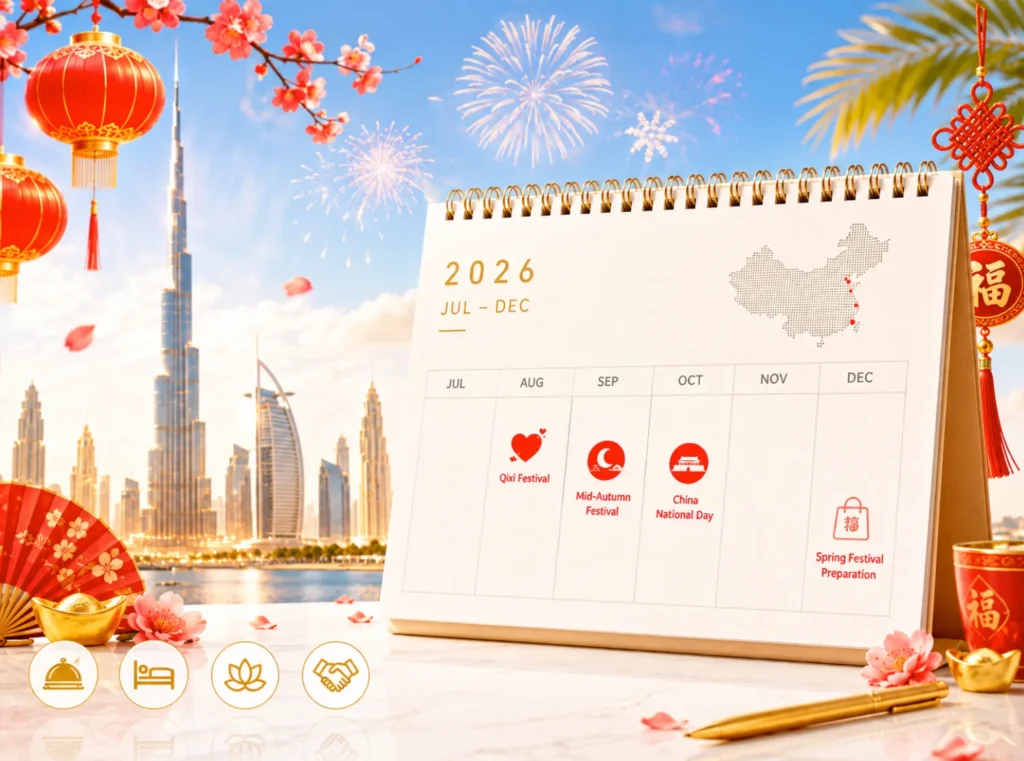
Introduction: The New Normal of Chinese Visitors Chinese tourists are reshaping Dubai’s dining and hospitality landscape. According to the latest data released by the Dubai Department of Economy and Tourism (DET), Dubai welcomed 860,000 Chinese overnight visitors in 2025, a steady increase from 824,000 in 2024. Looking further ahead, Chinese tourist spending in the Middle East is projected to grow by 130% from 2024 to 2030. At the same time, as of early 2026, the overseas Chinese resident population in the UAE stands at approximately 400,000, with about 150,000 living in Dubai. This community provides a stable year-round local consumer base. Additionally, the UAE offers visa-free entry to Chinese citizens, allowing Chinese passport holders to stay for 30 to 90 days without a visa. With an annual visitor volume of 860,000 plus a resident population of 400,000, the combined scale of Chinese tourists and residents far exceeds that of a single small county in China. This makes them a permanent, year-round market presence, not just “occasional visitors.” For Dubai’s restaurants, hotels, and premium service brands, understanding the consumption patterns of both Chinese tourists and residents is key to grasping their business growth trajectory. Why Dubai Businesses Need a China Marketing Calendar  A well‑planned marketing calendar helps businesses prepare content, advertising, promotions, and operational capacity well before customer demand peaks. However, a China marketing calendar designed for Dubai should not be identical to the one used in mainland China. The customers, consumption environment, and what you sell are fundamentally different. Chinese residents represent a year‑round market Chinese consumers are not only present during Golden Week holidays. The Chinese residents living in the UAE do not limit their spending to Chinese public holidays. They live, work, study, invest, and socialise locally all year round. Their purchasing decisions are influenced not only by traditional Chinese festivals but also by UAE weekends, school breaks, local events, business schedules, and family occasions. For restaurants, this means that daily operations must account for Chinese guests’ dining preferences, booking habits, and consumption scenarios – not just running a single promotion on a “Chinese festival”. For clinics and aesthetic medicine centres, long‑term residents may require ongoing consultations, treatment plans, health check‑ups, and regular maintenance procedures.Particularly ahead of the Spring Festival, Dubai’s aesthetic clinics typically experience a peak in bookings, with many long‑term residents arranging treatments early to rejuvenate their look for the New Year. For real estate agencies, legal advisors, and corporate service providers, Chinese residents and business owners may need professional support at different stages of relocation, investment, or business development. This segment is particularly valuable because it generates repeat business. A tourist might dine at a restaurant only once during a holiday, while a local resident can become a regular visitor, recommend the place to friends, and return with family members visiting Dubai. Therefore, a marketing calendar should enhance cultural relevance at specific times, rather than prompting businesses to start their China marketing only during a handful of Chinese festivals. Key China Marketing Opportunities in the Second Half of 2026 The Qixi Festival falls on 19 August 2026 (the 7th day of the 7th lunar month). It is China’s most romantic traditional festival and one of the most important “date‑economy” occasions for restaurants and hotels throughout the year. For Dubai’s F&B industry, the core opportunity lies in “couples dining experiences”. High‑end Chinese restaurants, venues with spectacular views, and fine‑dining outlets within hotels can launch exclusive Qixi set menus for two, private or semi‑private seating options, and complementary desserts or drinks. Hotels can bundle “stay + dinner + spa” packages to directly address Chinese consumers’ gifting needs. Health and aesthetic clinics can craft content around pre‑date preparations, confidence boosting, and self‑care – rather than relying on heavy discounts. Action tip: Start Qixi promotions 4‑6 weeks in advance. Use Rednote and WeChat Moments to showcase romantic two‑person dining settings, highlighting keywords such as “romantic”, “exclusive”, and “limited”. The 2026 Mid‑Autumn Festival holiday runs from 25 to 27 September – a 3‑day weekend (Friday to Sunday) with no need for adjusted working days. The core cultural themes of this festival are reunion, gift‑giving, and gratitude – which translate into three major marketing angles for Dubai’s F&B sector. Family dining scene:Mid‑Autumn is one of the most important family‑reunion occasions in Chinese culture. Chinese families living in Dubai, as well as visiting Chinese families travelling during this period, will seek high‑quality Chinese cuisine. Restaurants can launch reunion banquets and family‑sharing set menus. Corporate gifting scene: The festival is a key time for Chinese companies to maintain client relationships, and mooncake gift boxes are the standard corporate present. Dubai’s premium hotels and Chinese restaurants can create customised mooncake gift boxes or festive hampers for B2B sales to Chinese enterprises operating in the UAE. With over 6,190 Chinese companies already established in Dubai, this represents a significant corporate procurement market. Relationship‑nurturing scene: For Dubai brands serving high‑net‑worth Chinese clients – such as real estate, travel, and healthcare – Mid‑Autumn is the ideal moment to send seasonal greetings and strengthen client relationships. Action tip:Begin Mid‑Autumn promotions in mid‑August, targeting corporate clients with gift solutions and families with reunion dinner bookings. The 2026 National Day holiday runs from 1 October to 7 October – a full 7 days. This is the “annual peak”for outbound Chinese tourism and the most critical customer window for Dubai’s F&B and hospitality sectors. During this period, a large influx of Chinese tourists arrives in Dubai, visa‑free access makes spontaneous travel a reality. Restaurants should prepare in three key areas: Chinese‑language menus and service, booking system capacity, and exclusive packages tailored for Chinese tourists. Notably, a significant portion of Chinese visitors during National Day are business travellers and potential investors. Dubai is not only a tourism destination but also a popular choice for Chinese companies and individual investors. High‑end restaurants and  hotels can design “business banquet” packages or “investor networking dinners” to transform dining occasions into deeper commercial connections. Action tip:Finalise all promotional materials by mid‑September. Post National Day dining

From Search to AI Shortlists: How Chinese Customer Discovery Is Changing in 2026
China Marketing 101

From Search to AI Shortlists: How Chinese Customer Discovery Is Changing in 2026

Introduction: Why 2026 Is the Year AI Search Became the New Gateway to Chinese Consumers If your brand is not visible in Chinese AI search results, you are invisible to a huge number of Chinese consumers. That is the reality of 2026. Gartner projects that traditional search engine traffic will decline by 25% in 2026, with AI search market share potentially overtaking traditional search within the next two years. This shift is not gradual—it has already arrived. Chinese consumer discovery has moved from “search and browse” to “ask and receive.” Instead of typing keywords into Baidu and scrolling through pages of blue links, consumers now open Doubao, DeepSeek, or Kimi and ask natural-language questions. The AI synthesizes answers from across the web and serves a single, curated response. If your brand is not in that response, you never make it to the shortlist. From Baidu to ByteDance: How Chinese Users Search Today For years, the customer acquisition path for brands in China has been relatively clear: gain visibility on Baidu, build awareness on Xiaohongshu or Douyin, strengthen trust through WeChat, and guide interested users toward inquiries or purchases. That path has not disappeared.But by 2026, a new information gateway has emerged above these channels: AI‑assisted search and brand discovery. Chinese consumers no longer need to open a dozen web pages and compare each search result one by one. They can simply ask an AI assistant to filter suitable brands, explain the differences between options, check corporate reputations, and recommend next steps. For Dubai‑based businesses, therefore, the real question is no longer just: “Can our brand be found by Chinese consumers?” The more important question has become: “Can AI accurately understand our business, trust our information, and be willing to recommend us to users?” This marks the shift from traditional search visibility to AI visibility. Why DeepSeek, Kimi, Doubao and Yuanbao Have Sustained Their Growth  Unlike global markets where ChatGPT and Gemini dominate, China’s AI ecosystem has evolved in relative isolation due to regulatory frameworks, including the Great Firewall, as well as local data policies and language/cultural nuances. This has created a protected but fiercely competitive domestic arena.In this hyper‑competitive market, why have these four AI applications—DeepSeek, Kimi, Doubao, and Yuanbao—not only survived but thrived? Two factors explain their success: What Chinese Customers Ask AI Before Spending Consumers treat AI assistants as “advisors,” not search boxes. The questions they ask reveal a structured decision‑making journey that brands must understand—and optimize for.   The journey begins with broad discovery. Consumers ask: “Which brands offer [product/service] in [city]?” or “What are the best options for [need]?” At this stage, the AI does not necessarily recommend the most well‑known brands; it focuses more on relevance between the brand and the user’s needs.   Once a shortlist is formed, consumers dig deeper: “Compare Brand A and Brand B on price, quality, and customer service” or “Which one is better for [specific use case]?” A brand may have very attractive social media content, but the AI may still struggle to compare it—often because key information is scattered across different pages or exists only in images, videos, and promotional posters. Businesses need to publish the comparison criteria that consumers actually use in their real decision‑making. Before acting, users verify reputation, expertise, and authenticity. The AI’s trust assessment relies primarily on the platform’s own ecosystem—not the open web. For example, Doubao taps ByteDance’s internal reviews and news; Qwen uses Alibaba’s commerce/map data; Yuanbao leverages WeChat’s official accounts and mini‑program feedback. These internal sources are real‑time and context‑relevant. If negative information dominates within them, the AI flags it; if positive, it reinforces confidence.   When consumers approach the decision stage, their questions become more practical. “Where is it located?” “Is it in stock?” “How much does it cost?” “How do I book or buy?” If a business lacks these basic details, it adds friction to the user’s journey. AI can influence brand discovery and initial screening, but ultimately it is the business itself that must convert inquiries.  What This Change Means for Dubai Businesses For Dubai‑based brands targeting Chinese consumers, this shift means: you must optimize for AI visibility, not just Baidu rankings. But different industries cannot use identical AEO (AI Engine Optimization) strategies—because user needs, prompts, trust criteria, and purchase cycles vary across sectors. Dubai’s hotels and restaurants need to reach two related but distinct Chinese audiences: Chinese tourists planning a trip to Dubai, and Chinese residents already living in the UAE. When looking for dining options, Chinese tourists and local Chinese residents now ask Doubao or DeepSeek: “Which restaurants in Dubai serve authentic Chinese food?” or “Is the hotel close to major attractions?” If your hotel or restaurant information is not structured, visible, and positively represented in the AI‘s training data and real‑time sources, you won’t appear in the answer. Geopolitical uncertainty may affect some investors‘risk appetite or timing, but compared with short‑term consumption like tourism and dining, real estate investment usually has a longer decision‑making cycle. Investors focus more on long‑term value, asset safety, market stability, and exit possibilities. Therefore, real‑estate firms need to publish sufficiently detailed and logically clear content in both Chinese and English, explaining the investment rationale behind each project. The AI needs not only to know what project the company is selling, but also to understand:   * Which type of investor the project suits   * How the location differs from other areas   * How the payment structure works   * What risks investors need to assess   * What happens after they submit an inquiry Medical tourism is another high‑stakes category. Chinese patients researching Dubai clinics ask: “Do the doctors have professional qualifications?” “Is this clinic JCI‑accredited?” “Do the doctors understand Asian skin issues or Asian facial structures?” For clinics, the most valuable AEO content is not a pile of promotional adjectives; what truly helps is well‑structured, medically responsible information, such as doctors’ credentials, treatment suitability, procedures, post‑care, and so on. For law firms, corporate services, accounting, immigration, and market‑entry consultancies, clients are often buying not

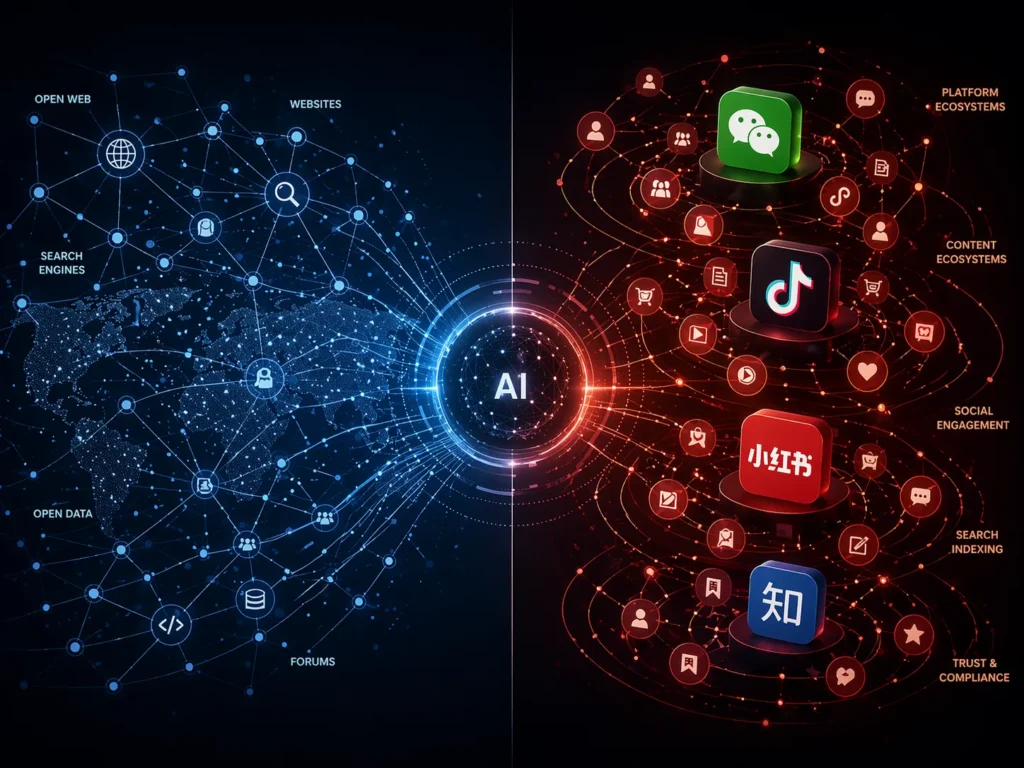
Split-screen illustration comparing global AI open web ecosystem and China’s platform-based AI ecosystem with a central AI layer
China Marketing 101

Why China’s AI Ecosystem Is Different from Global AI (And What Brands Must Do)

Quick Answer China’s AI ecosystem is different from the global AI ecosystem because it operates on a hybrid model that combines search engines, platform ecosystems, and social signals, rather than relying primarily on the open web. While the Great Firewall contributed to a separate digital infrastructure, the more important reality is this: High-value data in China is concentrated within major platforms like WeChat, Xiaohongshu, RedNote and Douyin. As a result: For multinational brands, this creates a critical visibility gap: Being recommended by ChatGPT does not guarantee visibility in Chinese AI tools like Doubao or Kimi. Global AI vs Chinese AI (Quick Comparison) Dimension Global AI Chinese AI Data Source Open web Hybrid (search + platforms + filtered data) Traffic Entry Standalone tools Standalone + embedded in platforms Trust Model Domain authority + public discussion Search signals + platform trust + social engagement + compliance Content Visibility Web indexing and citations Platform presence + search + engagement + localization User Interaction AI as destination AI as both destination and embedded layer Key Differences Between Global AI and Chinese AI 1. Data Source Chinese AI relies on a hybrid data system, not a purely closed ecosystem. This means Chinese AI is platform-centric but still partially search-integrated, not fully closed. 2. Traffic Entry Chinese AI operates as both standalone tools and embedded experiences. AI in China is not just an app—it is a layer integrated into user behavior across platforms. 3. Trust Model Chinese AI uses a multi-signal trust system, not purely social validation. Trust is multi-dimensional, combining search, platform, and compliance signals. 4. Content Visibility Visibility in Chinese AI depends on platform presence as much as search indexing. Content outside major platforms is significantly disadvantaged. Why China’s AI Ecosystem Is Structurally Independent The Role of the Great Firewall China’s AI ecosystem developed separately due to limited access to global platforms. Global tools like Google, ChatGPT, and Claude are not officially accessible in mainland China. To meet domestic demand, China built its own ecosystem: However, China is not fully isolated from all external data. It is more accurate to describe the system as structurally independent. The Rise of Platform Ecosystems High-value data in China is concentrated within major platforms. Content such as: is primarily generated and stored inside platform ecosystems. This makes platform presence essential for visibility, even though search still matters. The Emergence of Local AI Models Chinese AI models operate primarily within local data environments. Major models include: These systems are optimized for: How Global AI and Chinese AI Differ in Practice Traffic Entry Points Global AI is primarily a destination, while Chinese AI is both destination and embedded layer. Trust and Ranking Logic Chinese AI uses a hybrid ranking system. This creates a fundamentally different ranking logic. Business Impact: The Citation Gap Multinational brands face a visibility gap between global AI and Chinese AI systems. A brand may perform well in: But still fail in China. Because Chinese AI depends on different: Brands optimized only for the open web risk becoming invisible in Chinese AI environments. What Multinational Brands Should Do 1. Build Content Inside Chinese Platforms Platform presence is mandatory, not optional. Focus on: … 2. Optimize for Multi-Signal Trust Social proof matters, but it is not enough alone. Optimize for: 3. Create Localized Content Localization is critical for visibility. 4. Maintain Search Presence China is not “post-search”. Do not ignore: 5. Track Visibility in Chinese AI Tools Visibility must be measured inside the ecosystem. Monitor: Final Takeaway China’s AI ecosystem is not simply a localized version of the global internet. It is a hybrid system shaped by: For brands, success in global AI does not guarantee success in China. Each ecosystem requires its own strategy, content model, and optimization approach.

Mastering WeCom-The Official Registration and Verification Guide for BrandsA6-1
China Marketing 101

Mastering WeCom: The Official Registration and Verification Guide for Brands

Introduction: The Professional Bridge to Wechat UsersAs we have explored in our series on China’s digital landscape, the WeChat ecosystem is the undisputed digital headquarters for any brand entering this market. However, for an international brand—whether you are a luxury property developer, a premium hospitality group, or a high-end retailer—interacting with Chinese consumers through personal accounts is a significant risk. It lacks the professional authority required for high-value transactions and offers no data security for the brand.This is where WeCom (the international version of Enterprise WeChat) becomes essential. WeCom is the professional CRM foundation that allows your team to communicate with customers on their personal WeChat while maintaining a verified corporate identity. For a brand, a verified WeCom account provides a badge of trust, unlocks advanced marketing tools, and ensures that your customer relationships remain a corporate asset. This guide provides a concise, step-by-step walkthrough of the registration and verification process specifically for international entities. Why WeCom Verification is Mandatory for SuccessVerification is not just a cosmetic upgrade; it is a security and functional necessity in a market where trust is the primary currency. For brands, the benefits of a verified WeCom account include:Verified Professional Identity: Staff profiles display a verified shield and the official brand name, immediately separating your team from unverified individual agents or potential bad actors.Asset Protection: Customer contacts remain within the brand’s system even if a sales representative leaves the company, ensuring no loss of institutional memory.Advanced Feature Access: Verification unlocks higher customer capacity, official lead generation tools on Rednote, and the ability to integrate with global CRM systems.Legal & Security Compliance: Rigorous third-party audits protect the legal rights of both the brand and the consumer, creating a safer environment for high-value transactions.📌 Why it matters: In the 2026 digital landscape, consumers expect a “frictionless” yet “secure” journey. A verified account provides the “Blue V” credibility that is required to move a user from a casual social media follower to a high-value client. Conclusion: The Foundation of Your China StrategyFor brands looking to scale, it provides the necessary bridge to interact with the world’s most powerful consumer market in a way that is secure, professional, and scalable.🔹 Verify with your Commercial License to unlock the professional trust badge.🔹 Connect your sales team to the 1.414 billion users on WeChat.🔹 Own your customer data through a centralized, professional CRM.🚀 Ready to verify your brand on WeCom?Navigating the technical requirements of the international registration and audit process can be complex. We specialize in helping brands build their professional CRM infrastructure to ensure a smooth and successful entry into the Chinese market.📩 Contact us today to start your WeCom verification and secure your brand’s digital future!

Why an Account Matrix is Your Brand's Essential Digital Infrastructure-A5-1
China Marketing 101

Why an Account Matrix is Your Brand’s Essential Digital Infrastructure

Introduction: From Singular Accounts to Digital EcosystemsFor international brands entering the Chinese digital landscape, the concept of an “Account Matrix” often sounds like an advanced marketing tactic. However, with WeChat reaching 1.414 billion users and Rednote becoming the primary search engine for lifestyle decisions, a matrix is no longer a “bonus strategy”—it is fundamental digital infrastructure. In the Middle East, particularly for sectors like Dubai real estate, luxury retail, and bespoke tourism, relying on a single account is like opening one boutique in a massive city and hoping the entire population finds you.An Account Matrix is the strategic coordination of multiple accounts—either across different platforms or within a single platform—to achieve a common brand goal. It is the difference between a single “digital storefront” and a comprehensive “digital network.” This multi-layered approach allows a brand to cover different user needs, diversify operational risks, and dominate search results. This guide explores the two types of matrices—Horizontal and Vertical—and provides a framework for brands to decide which infrastructure best suits their business goals. Conclusion: The Matrix is Your Competitive AdvantageIn 2026, the brands that dominate the Middle East market in China will be those that move beyond the “Single Account” mindset. A single account is a point of contact; a matrix is a net that captures every potential lead.🔹 Horizontal Matrices build the breadth needed for market-wide awareness.🔹 Vertical Matrices build the depth needed for high-value conversion.🔹 Centralized CRM ensures that every interaction results in a measurable lead.For brands in Dubai and the wider Middle East, building an account matrix is the most effective way to build a “Searchable Reputation” that results in long-term, sustainable growth in the world’s most sophisticated consumer market.🚀 Ready to build your brand’s digital infrastructure?Building a matrix requires a strategic blend of persona development, platform-specific content, and centralized management. We specialize in helping Middle East brands architect and operate high-conversion account ecosystems.📩 Contact us today to start building your digital matrix!

Scroll to Top
contact us

Contact us

Get a free marketing consultation for your business