
Introduction: Why 2026 Is the Year AI Search Became the New Gateway to Chinese Consumers
If your brand is not visible in Chinese AI search results, you are invisible to a huge number of Chinese consumers. That is the reality of 2026.
Gartner projects that traditional search engine traffic will decline by 25% in 2026, with AI search market share potentially overtaking traditional search within the next two years. This shift is not gradual—it has already arrived.
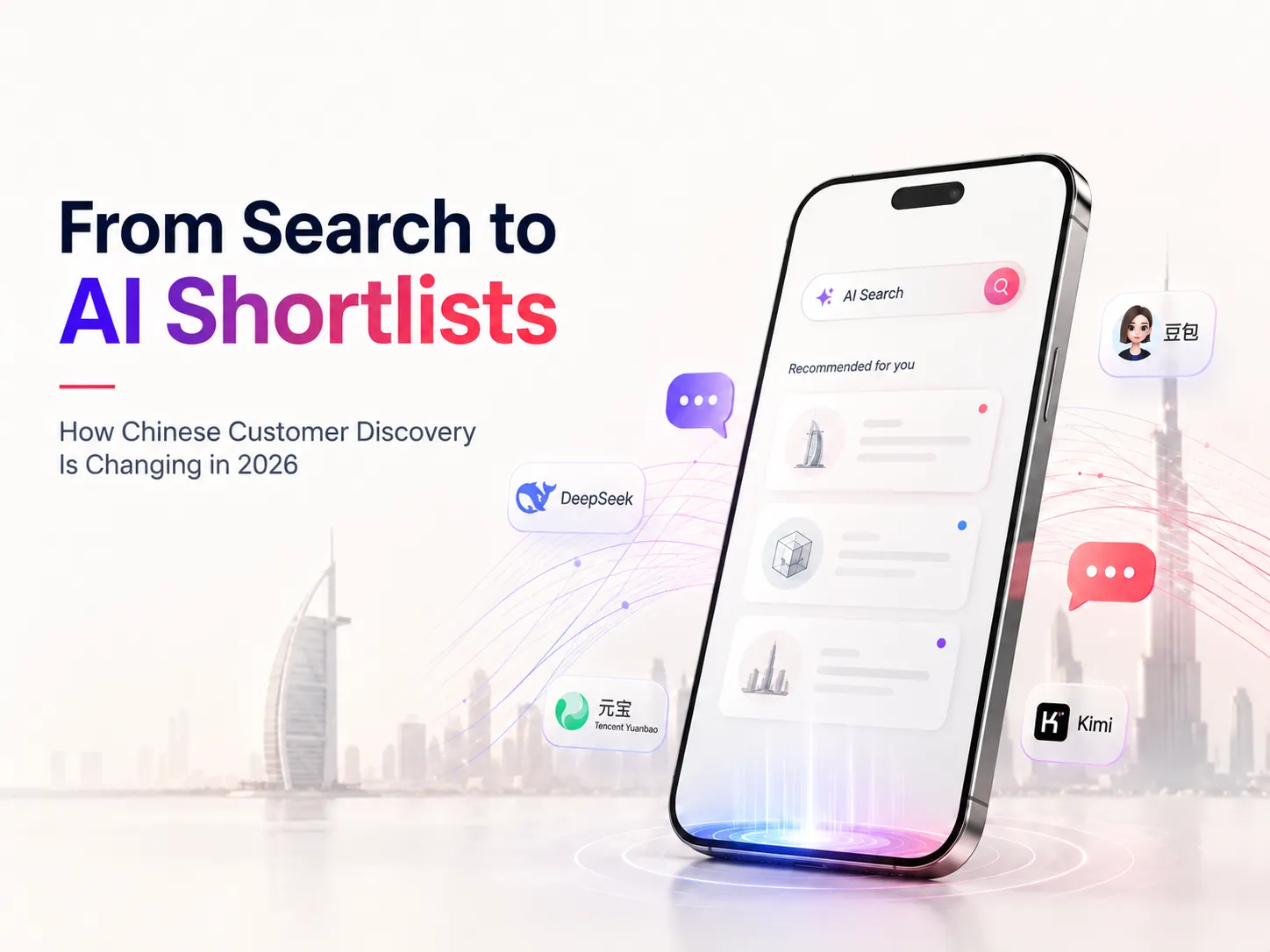
Chinese consumer discovery has moved from “search and browse” to “ask and receive.” Instead of typing keywords into Baidu and scrolling through pages of blue links, consumers now open Doubao, DeepSeek, or Kimi and ask natural-language questions. The AI synthesizes answers from across the web and serves a single, curated response. If your brand is not in that response, you never make it to the shortlist.
From Baidu to ByteDance: How Chinese Users Search Today
For years, the customer acquisition path for brands in China has been relatively clear: gain visibility on Baidu, build awareness on Xiaohongshu or Douyin, strengthen trust through WeChat, and guide interested users toward inquiries or purchases.
That path has not disappeared.But by 2026, a new information gateway has emerged above these channels: AI‑assisted search and brand discovery. Chinese consumers no longer need to open a dozen web pages and compare each search result one by one. They can simply ask an AI assistant to filter suitable brands, explain the differences between options, check corporate reputations, and recommend next steps.
For Dubai‑based businesses, therefore, the real question is no longer just: “Can our brand be found by Chinese consumers?” The more important question has become: “Can AI accurately understand our business, trust our information, and be willing to recommend us to users?” This marks the shift from traditional search visibility to AI visibility.
Why DeepSeek, Kimi, Doubao and Yuanbao Have Sustained Their Growth
Unlike global markets where ChatGPT and Gemini dominate, China’s AI ecosystem has evolved in relative isolation due to regulatory frameworks, including the Great Firewall, as well as local data policies and language/cultural nuances. This has created a protected but fiercely competitive domestic arena.In this hyper‑competitive market, why have these four AI applications—DeepSeek, Kimi, Doubao, and Yuanbao—not only survived but thrived? Two factors explain their success:
- Ease of use. These apps are free, mobile‑first, and require zero learning curve. Voice input, natural conversation, and instant answers make them more intuitive than traditional search. This is especially important for older users. For users aged 60 and above, whether an app is easy to use and can solve real‑world problems determines their adoption. Take the 60‑year‑old demographic as an example: a grandmother in Zhejiang now uses Doubao and DeepSeek daily. She directly asks voice questions, asks the AI to draft travel plans, and inquires which hospital better suits her needs.
- Ecosystem integration. Doubao is natively embedded within ByteDance’s super‑app ecosystem (Douyin/TikTok China, Toutiao, etc.); Qwen powers services across Alibaba’s universe—Taobao, Alipay, Fliggy, and Amap; Yuanbao connects seamlessly to Tencent’s WeChat. To appreciate the value of this integration, consider the sheer scale: Douyin (TikTok China) has over 750 million daily active users, and WeChat exceeds 1.3 billion monthly active users, these are apps that a vast majority of China’s internet population open multiple times a day. When AI is built directly into these platforms, users don’t need to download a separate app or learn a new interface.
What Chinese Customers Ask AI Before Spending
Consumers treat AI assistants as “advisors,” not search boxes. The questions they ask reveal a structured decision‑making journey that brands must understand—and optimize for.
- Discovery prompts: finding suitable brands
The journey begins with broad discovery. Consumers ask: “Which brands offer [product/service] in [city]?” or “What are the best options for [need]?” At this stage, the AI does not necessarily recommend the most well‑known brands; it focuses more on relevance between the brand and the user’s needs.
- Comparison prompts: evaluating alternatives
Once a shortlist is formed, consumers dig deeper: “Compare Brand A and Brand B on price, quality, and customer service” or “Which one is better for [specific use case]?” A brand may have very attractive social media content, but the AI may still struggle to compare it—often because key information is scattered across different pages or exists only in images, videos, and promotional posters. Businesses need to publish the comparison criteria that consumers actually use in their real decision‑making.
- Trust prompts: l checking reputation, expertise and authenticity
Before acting, users verify reputation, expertise, and authenticity. The AI’s trust assessment relies primarily on the platform’s own ecosystem—not the open web. For example, Doubao taps ByteDance’s internal reviews and news; Qwen uses Alibaba’s commerce/map data; Yuanbao leverages WeChat’s official accounts and mini‑program feedback. These internal sources are real‑time and context‑relevant. If negative information dominates within them, the AI flags it; if positive, it reinforces confidence.
- Conversion prompts: location, availability, price range and next steps
When consumers approach the decision stage, their questions become more practical. “Where is it located?” “Is it in stock?” “How much does it cost?” “How do I book or buy?” If a business lacks these basic details, it adds friction to the user’s journey. AI can influence brand discovery and initial screening, but ultimately it is the business itself that must convert inquiries.
What This Change Means for Dubai Businesses
For Dubai‑based brands targeting Chinese consumers, this shift means: you must optimize for AI visibility, not just Baidu rankings.
But different industries cannot use identical AEO (AI Engine Optimization) strategies—because user needs, prompts, trust criteria, and purchase cycles vary across sectors.
- Hotels and restaurants: competing for shortlist inclusion
Dubai’s hotels and restaurants need to reach two related but distinct Chinese audiences: Chinese tourists planning a trip to Dubai, and Chinese residents already living in the UAE. When looking for dining options, Chinese tourists and local Chinese residents now ask Doubao or DeepSeek: “Which restaurants in Dubai serve authentic Chinese food?” or “Is the hotel close to major attractions?” If your hotel or restaurant information is not structured, visible, and positively represented in the AI‘s training data and real‑time sources, you won’t appear in the answer.
- Real‑estate brands: competing for qualified investor attention
Geopolitical uncertainty may affect some investors‘risk appetite or timing, but compared with short‑term consumption like tourism and dining, real estate investment usually has a longer decision‑making cycle. Investors focus more on long‑term value, asset safety, market stability, and exit possibilities. Therefore, real‑estate firms need to publish sufficiently detailed and logically clear content in both Chinese and English, explaining the investment rationale behind each project. The AI needs not only to know what project the company is selling, but also to understand:
* Which type of investor the project suits
* How the location differs from other areas
* How the payment structure works
* What risks investors need to assess
* What happens after they submit an inquiry
- Clinics: competing on expertise, safety and trust
Medical tourism is another high‑stakes category. Chinese patients researching Dubai clinics ask: “Do the doctors have professional qualifications?” “Is this clinic JCI‑accredited?” “Do the doctors understand Asian skin issues or Asian facial structures?” For clinics, the most valuable AEO content is not a pile of promotional adjectives; what truly helps is well‑structured, medically responsible information, such as doctors’ credentials, treatment suitability, procedures, post‑care, and so on.
- Professional services: competing on credibility and local knowledge
For law firms, corporate services, accounting, immigration, and market‑entry consultancies, clients are often buying not a physical product but professional judgment and problem‑solving ability. Chinese companies expanding to Dubai ask AI: “Which Dubai law firm specializes in Chinese corporate investment?” “What are the visa requirements for setting up a company in DIFC?” Professional services need to demonstrate their capabilities through: clear service pages, professional knowledge, transparent team credentials, real‑scenario case explanations, etc. The goal is to enable AI to accurately identify the firm’s professional category and have sufficient evidence to recommend it as a trusted local service provider.
Conclusion: 2026 Is the Year AI Became the Gateway to Chinese Consumers, and Future Search Results Will Be a Curated Shortlist
Baidu, Xiaohongshu, WeChat, and Douyin are still very important. But AI assistants are gradually positioning themselves above these channels—organizing, interpreting, and judging different pieces of information, and deciding which brands deserve further user attention.
Want your brand to stay ahead in the age of AI search?
CMEA specializes in helping Dubai‑based brands achieve visibility in Chinese AI search results. From Chinese‑language content strategy and media placements to technical AEO optimization and trust‑signal building, CMEA ensures that when Chinese consumers ask AI about your category, your brand becomes the one the AI remembers.
Contact us now—don’t let your brand become invisible in the AI‑search era. Start your AI visibility journey now!