
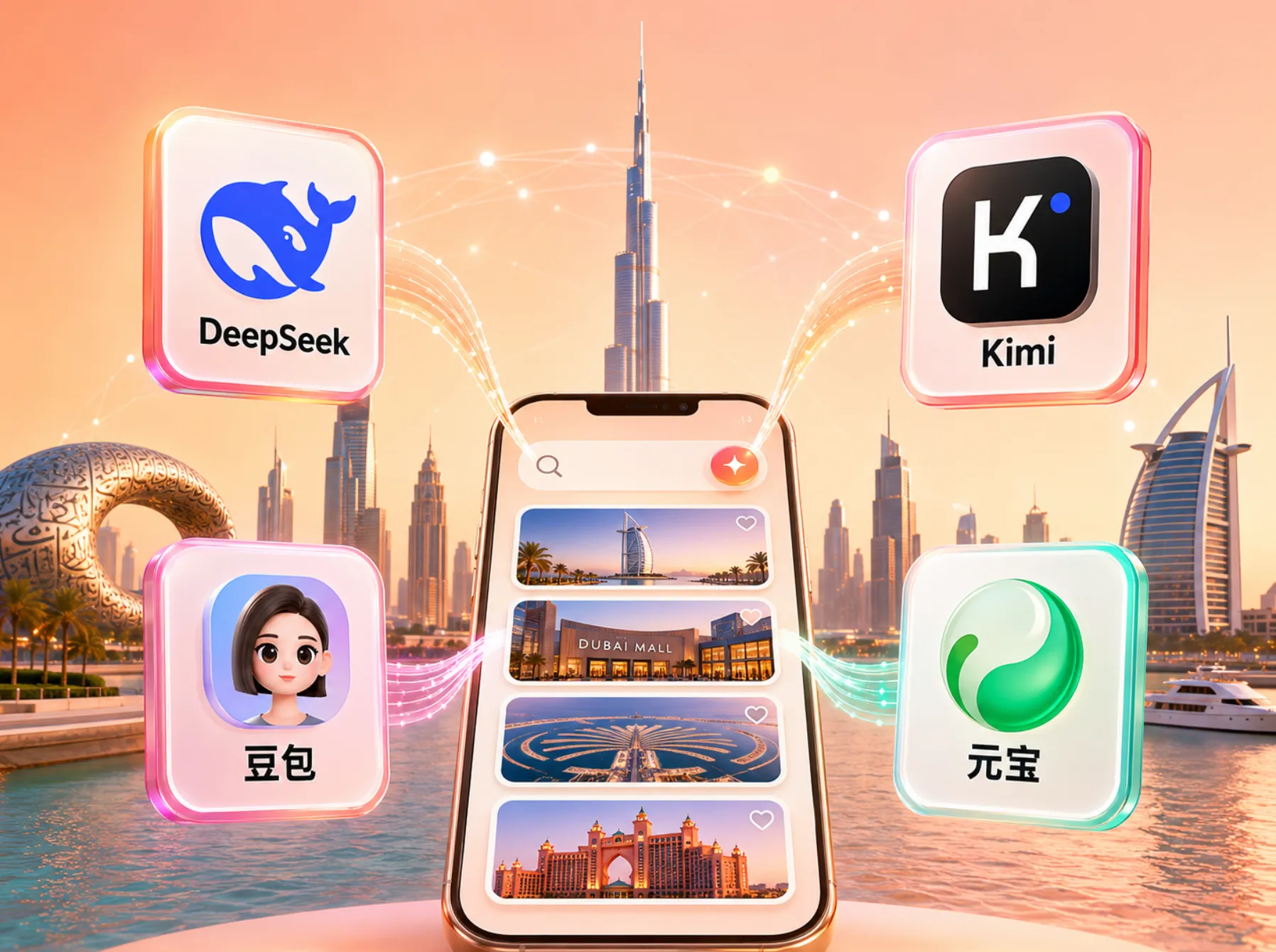
Introduction: 86% of Chinese Consumers Use AI Tools Weekly – and It Is Changing Everything
The way Chinese consumers discover, evaluate, and choose brands is undergoing a fundamental transformation. According to an Accenture consumer survey, by January 2026, 86% of Chinese consumers were using AI tools at least once a week – far above the global average of approximately 57%; 37% of consumers were already using AI during the shopping process, mainly to understand unfamiliar categories and compare brands quickly. For international brands targeting Chinese consumers, this is not a distant trend. It is already reshaping how customers discover, compare and shortlist businesses.
OC&C research shows that AI tools have risen to become the fourth-largest decision-making channel for Chinese consumers, behind traditional e-commerce platforms and livestreaming platforms, influencing 37% of purchasing decisions. More importantly, consumer trust in recommendations from AI assistants has reached 21%, exceeding trust in celebrity endorsements (19%) for the first time.
More importantly, over half of AI tool users say that AI has already replaced search engines as the way they access information. AI is not simply helping users search for information; it is shortlisting brands for them.
The AI Revolution in Chinese Consumer Decision-Making
·From “Searching” to “Being Given the Answer”
The traditional consumer decision funnel – “search box -> product matrix -> shopping cart” – is now being replaced by a new paradigm: “AI intent recognition -> personalised recommendation -> AI-assisted price comparison -> user confirmation”.
Christine Wang, President of Accenture Song Greater China, put it precisely: “In the future, brands will need not only to appeal to consumers, but also to their AI assistants.”
This means that when a Chinese traveller asks an AI assistant to recommend luxury hotels in Dubai, compare medical providers in Singapore, or evaluate universities in the UK. AI is not simply passing on information. It is curating, filtering, and recommending whose links should rank higher. In effect, it acts as a gatekeeper between brands and consumers.
The Four AI Tools Reshaping How Chinese Consumers Discover Brands
·Doubao – the Mass-Market Giant with 382 Million Monthly Active Users
Developed by ByteDance, the parent company of Douyin and TikTok, Doubao is the undisputed leader in China’s AI market. As of June 2026, Doubao had 382 million monthly active users, more than its next two competitors combined. Its year-on-year growth rate reached 172.1%.
Doubao’s strength lies in its ease of use. With a low barrier to entry, it is a mass-market AI assistant that Chinese consumers use for everything from everyday dining choices to travel planning. User behaviour is characterised by short, frequent interactions, with 40.6% of sessions lasting less than three minutes.
For hotels, restaurants, attractions, and local lifestyle brands, Doubao may be the first place consumers ask for recommendations related to Dubai. The clarity of a brand’s information, the depth of its Chinese-language content, and the consistency of third-party reviews can all influence the answer.
·DeepSeek – the Tech-Savvy Choice with 130 Million Monthly Active Users
DeepSeek has approximately 130 million monthly active users and is more commonly used for complex comparisons, logical analysis, and in-depth research.
When users evaluate Dubai property investments, healthcare services, educational institutions, or B2B partners, they may ask DeepSeek to compare prices, credentials, risks, and brand differences. In these situations, simple promotional slogans have limited value. Clearly structured, reliable, and mutually consistent information is far more important.
·Kimi – the Deep-Research Specialist with 85 Million Monthly Active Users
Although Kimi’s user base is smaller than that of the leading platforms, Kimi’s value lies in professional depth rather than reach. It excels at processing long-form content and complex research requirements, making it suitable for consumers who need to investigate a topic in detail.
Although Kimi’s reach has contracted, its users remain highly engaged and often compare information across multiple AI tools. For example, 25% of car buyers use three or more AI tools for cross-verification – the highest proportion across all categories.
·Yuanbao – the Rising Contender
Tencent’s strategic AI product Yuanbao reached 114 million monthly active users in February 2026, with more than 50 million daily active users. By March 2026, however, its monthly active user base had fallen to approximately 49.84 million.
Yuanbao is supported by Tencent’s vast ecosystem, including deep integration with WeChat. This is especially important for Dubai brands because WeChat remains a cornerstone of engagement between Chinese consumers and businesses in the UAE. For Dubai businesses seeking to build long-term customer relationships, Yuanbao deserves continued attention.
What This Means for International Brands
·Your Brand Is Being Evaluated – Whether You Know It or Not
The AI revolution in Chinese consumer behaviour is not optional; it is already here. Every day, millions of Chinese consumers ask AI tools for recommendations about Dubai – where to stay, what to do, and which brands they can trust.
The question is not whether AI will influence how Chinese consumers perceive your brand, but whether you are actively shaping what AI says about it.
·The Cost of Being “Invisible” Is Higher Than You Think
In traditional search, a lower ranking still gives a brand some chance of being seen. In an AI recommendation environment, failing to enter the shortlist often means being eliminated at the beginning of the decision process. The consumer may never visit your website, see your advertising, or submit an enquiry. Your business may not even realise that it has lost a potential customer.
This is why AEO and AI Search Visibility are becoming increasingly important: businesses need to understand how AI identifies their brands and which high-value questions their brands are absent from.
If your brand does not appear in an AI-generated shortlist, you are not losing only one customer, but every potential customer who relies on that AI tool.
·RedNote and WeChat Are the Foundation; AI Is the Multiplier
RedNote and WeChat remain the foundations of marketing to Chinese consumers. They are where brand stories are told, communities are built, and consumer trust is nurtured.
But a foundation alone is no longer enough. AI is the multiplier. The content you create on RedNote and WeChat becomes raw material for AI tools when they generate recommendations. Your brand story, unique selling points, and customer reviews all contribute to AI’s understanding of your brand and help determine whether it recommends you.
Conclusion: The AI Recommendation Gap Is Forming
We are witnessing the early signs of a recommendation gap – the divide between brands that appear in AI-generated shortlists and those that do not. As AI tools become more advanced and more deeply embedded in consumer decision-making, this gap will only continue to widen.
CMEA helps international brands understand and strengthen their visibility across China’s evolving AI and digital ecosystem. By combining Chinese language content, RedNote, WeChat, KOL and KOC activity, and brand entity optimisation, we build a more complete discovery path for Chinese consumers.
Ready for Chinese AI tools to recommend your Dubai brand? Contact CMEA today.