
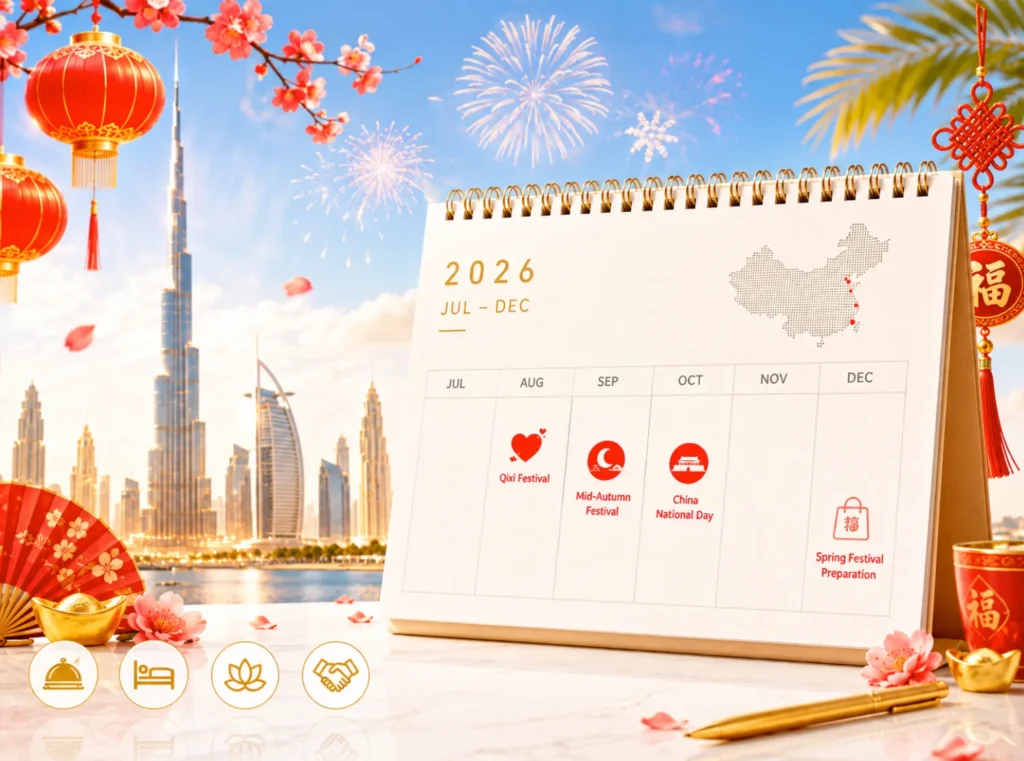
China Marketing Calendar for the Second Half of 2026: Key Dates Every Dubai Business Must Know
Introduction: The New Normal of Chinese Visitors Chinese tourists are reshaping Dubai’s dining and hospitality landscape. According to the latest data released by the Dubai Department of Economy and Tourism (DET), Dubai welcomed 860,000 Chinese overnight visitors in 2025, a steady increase from 824,000 in 2024. Looking further ahead, Chinese tourist spending in the Middle East is projected to grow by 130% from 2024 to 2030. At the same time, as of early 2026, the overseas Chinese resident population in the UAE stands at approximately 400,000, with about 150,000 living in Dubai. This community provides a stable year-round local consumer base. Additionally, the UAE offers visa-free entry to Chinese citizens, allowing Chinese passport holders to stay for 30 to 90 days without a visa. With an annual visitor volume of 860,000 plus a resident population of 400,000, the combined scale of Chinese tourists and residents far exceeds that of a single small county in China. This makes them a permanent, year-round market presence, not just “occasional visitors.” For Dubai’s restaurants, hotels, and premium service brands, understanding the consumption patterns of both Chinese tourists and residents is key to grasping their business growth trajectory. Why Dubai Businesses Need a China Marketing Calendar A well‑planned marketing calendar helps businesses prepare content, advertising, promotions, and operational capacity well before customer demand peaks. However, a China marketing calendar designed for Dubai should not be identical to the one used in mainland China. The customers, consumption environment, and what you sell are fundamentally different. Chinese residents represent a year‑round market Chinese consumers are not only present during Golden Week holidays. The Chinese residents living in the UAE do not limit their spending to Chinese public holidays. They live, work, study, invest, and socialise locally all year round. Their purchasing decisions are influenced not only by traditional Chinese festivals but also by UAE weekends, school breaks, local events, business schedules, and family occasions. For restaurants, this means that daily operations must account for Chinese guests’ dining preferences, booking habits, and consumption scenarios – not just running a single promotion on a “Chinese festival”. For clinics and aesthetic medicine centres, long‑term residents may require ongoing consultations, treatment plans, health check‑ups, and regular maintenance procedures.Particularly ahead of the Spring Festival, Dubai’s aesthetic clinics typically experience a peak in bookings, with many long‑term residents arranging treatments early to rejuvenate their look for the New Year. For real estate agencies, legal advisors, and corporate service providers, Chinese residents and business owners may need professional support at different stages of relocation, investment, or business development. This segment is particularly valuable because it generates repeat business. A tourist might dine at a restaurant only once during a holiday, while a local resident can become a regular visitor, recommend the place to friends, and return with family members visiting Dubai. Therefore, a marketing calendar should enhance cultural relevance at specific times, rather than prompting businesses to start their China marketing only during a handful of Chinese festivals. Key China Marketing Opportunities in the Second Half of 2026 The Qixi Festival falls on 19 August 2026 (the 7th day of the 7th lunar month). It is China’s most romantic traditional festival and one of the most important “date‑economy” occasions for restaurants and hotels throughout the year. For Dubai’s F&B industry, the core opportunity lies in “couples dining experiences”. High‑end Chinese restaurants, venues with spectacular views, and fine‑dining outlets within hotels can launch exclusive Qixi set menus for two, private or semi‑private seating options, and complementary desserts or drinks. Hotels can bundle “stay + dinner + spa” packages to directly address Chinese consumers’ gifting needs. Health and aesthetic clinics can craft content around pre‑date preparations, confidence boosting, and self‑care – rather than relying on heavy discounts. Action tip: Start Qixi promotions 4‑6 weeks in advance. Use Rednote and WeChat Moments to showcase romantic two‑person dining settings, highlighting keywords such as “romantic”, “exclusive”, and “limited”. The 2026 Mid‑Autumn Festival holiday runs from 25 to 27 September – a 3‑day weekend (Friday to Sunday) with no need for adjusted working days. The core cultural themes of this festival are reunion, gift‑giving, and gratitude – which translate into three major marketing angles for Dubai’s F&B sector. Family dining scene:Mid‑Autumn is one of the most important family‑reunion occasions in Chinese culture. Chinese families living in Dubai, as well as visiting Chinese families travelling during this period, will seek high‑quality Chinese cuisine. Restaurants can launch reunion banquets and family‑sharing set menus. Corporate gifting scene: The festival is a key time for Chinese companies to maintain client relationships, and mooncake gift boxes are the standard corporate present. Dubai’s premium hotels and Chinese restaurants can create customised mooncake gift boxes or festive hampers for B2B sales to Chinese enterprises operating in the UAE. With over 6,190 Chinese companies already established in Dubai, this represents a significant corporate procurement market. Relationship‑nurturing scene: For Dubai brands serving high‑net‑worth Chinese clients – such as real estate, travel, and healthcare – Mid‑Autumn is the ideal moment to send seasonal greetings and strengthen client relationships. Action tip:Begin Mid‑Autumn promotions in mid‑August, targeting corporate clients with gift solutions and families with reunion dinner bookings. The 2026 National Day holiday runs from 1 October to 7 October – a full 7 days. This is the “annual peak”for outbound Chinese tourism and the most critical customer window for Dubai’s F&B and hospitality sectors. During this period, a large influx of Chinese tourists arrives in Dubai, visa‑free access makes spontaneous travel a reality. Restaurants should prepare in three key areas: Chinese‑language menus and service, booking system capacity, and exclusive packages tailored for Chinese tourists. Notably, a significant portion of Chinese visitors during National Day are business travellers and potential investors. Dubai is not only a tourism destination but also a popular choice for Chinese companies and individual investors. High‑end restaurants and hotels can design “business banquet” packages or “investor networking dinners” to transform dining occasions into deeper commercial connections. Action tip:Finalise all promotional materials by mid‑September. Post National Day dining