
Quick Answer
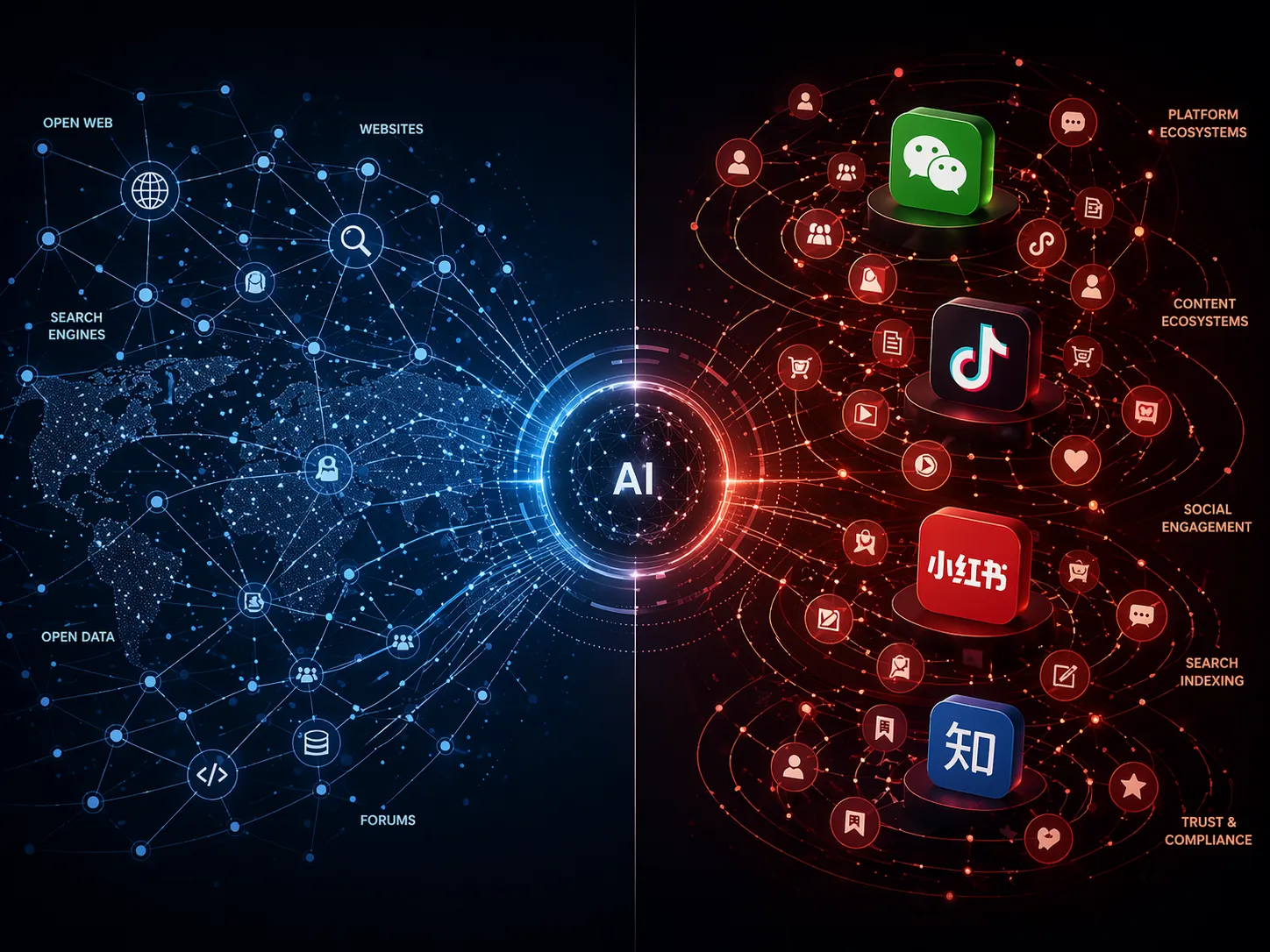
China’s AI ecosystem is different from the global AI ecosystem because it operates on a hybrid model that combines search engines, platform ecosystems, and social signals, rather than relying primarily on the open web.
While the Great Firewall contributed to a separate digital infrastructure, the more important reality is this:
High-value data in China is concentrated within major platforms like WeChat, Xiaohongshu, RedNote and Douyin.
As a result:
- Global AI systems rely on open web content, structured data, and public discussions
- Chinese AI systems rely on platform ecosystems, search indexing, and multi-layered trust signals
For multinational brands, this creates a critical visibility gap:
Being recommended by ChatGPT does not guarantee visibility in Chinese AI tools like Doubao or Kimi.
Global AI vs Chinese AI (Quick Comparison)
| Dimension | Global AI | Chinese AI |
|---|---|---|
| Data Source | Open web | Hybrid (search + platforms + filtered data) |
| Traffic Entry | Standalone tools | Standalone + embedded in platforms |
| Trust Model | Domain authority + public discussion | Search signals + platform trust + social engagement + compliance |
| Content Visibility | Web indexing and citations | Platform presence + search + engagement + localization |
| User Interaction | AI as destination | AI as both destination and embedded layer |
Key Differences Between Global AI and Chinese AI
1. Data Source
Chinese AI relies on a hybrid data system, not a purely closed ecosystem.
- Global AI:
- Open web (websites, forums, structured data)
- Chinese AI:
- Search engines (e.g. Baidu indexing)
- Closed ecosystems (WeChat, RedNote, Douyin)
- Platform-native content pools
- Compliance-filtered datasets
This means Chinese AI is platform-centric but still partially search-integrated, not fully closed.
2. Traffic Entry
Chinese AI operates as both standalone tools and embedded experiences.
- Global AI:
- Standalone tools (ChatGPT, Perplexity)
- Chinese AI:
- Standalone tools (Kimi, Doubao, ERNIE Bot, Tencent Yuanbao)
- Embedded AI (Baidu search, Douyin feeds, RedNote discovery)
AI in China is not just an app—it is a layer integrated into user behavior across platforms.
3. Trust Model
Chinese AI uses a multi-signal trust system, not purely social validation.
- Global AI:
- Domain authority
- Structured content
- Open discussions (e.g. Reddit, official sites)
- Chinese AI:
- Search relevance and indexing
- Platform credibility
- Social engagement (likes, saves, comments)
- Content freshness
- Regulatory filtering
Trust is multi-dimensional, combining search, platform, and compliance signals.
4. Content Visibility
Visibility in Chinese AI depends on platform presence as much as search indexing.
- Global AI:
- Driven by web presence, indexing, and citations
- Chinese AI:
- Platform presence (WeChat, RedNote, Douyin,Zhihu…)
- Search engine visibility (e.g. Baidu)
- Engagement signals
- Localization (language and format)
Content outside major platforms is significantly disadvantaged.
Why China’s AI Ecosystem Is Structurally Independent
The Role of the Great Firewall
China’s AI ecosystem developed separately due to limited access to global platforms.
Global tools like Google, ChatGPT, and Claude are not officially accessible in mainland China.
To meet domestic demand, China built its own ecosystem:
- Baidu (search + AI)
- WeChat (content + distribution)
- Xiaohongshu and Douyin (discovery platforms)
However, China is not fully isolated from all external data.
It is more accurate to describe the system as structurally independent.
The Rise of Platform Ecosystems
High-value data in China is concentrated within major platforms.
Content such as:
- product reviews
- user behaviour
- buying decisions
is primarily generated and stored inside platform ecosystems.
This makes platform presence essential for visibility, even though search still matters.
The Emergence of Local AI Models
Chinese AI models operate primarily within local data environments.
Major models include:
- Doubao
- Kimi
- ERNIE Bot
These systems are optimized for:
- domestic platforms
- local user behavior
- regulatory requirements
How Global AI and Chinese AI Differ in Practice
Traffic Entry Points
Global AI is primarily a destination, while Chinese AI is both destination and embedded layer.
- Global AI:
- Users actively open ChatGPT or similar tools
- Chinese AI:
- Users open standalone tools
- Users encounter AI inside platforms (Baidu, Douyin, Xiaohongshu)
Trust and Ranking Logic
Chinese AI uses a hybrid ranking system.
- Global AI prioritizes:
- authoritative websites
- structured data
- open discussions
- Chinese AI prioritizes:
- search signals (relevance, indexing, freshness)
- platform content supply
- engagement metrics
- platform trust
- regulatory compliance
This creates a fundamentally different ranking logic.
Business Impact: The Citation Gap
Multinational brands face a visibility gap between global AI and Chinese AI systems.
A brand may perform well in:
- ChatGPT
- Google AI
- global search
But still fail in China.
Because Chinese AI depends on different:
- data sources
- indexing systems
- platforms
- user behaviors
Brands optimized only for the open web risk becoming invisible in Chinese AI environments.
What Multinational Brands Should Do
1. Build Content Inside Chinese Platforms
Platform presence is mandatory, not optional.
Focus on:
- Xiaohongshu
- Douyin
…
2. Optimize for Multi-Signal Trust
Social proof matters, but it is not enough alone.
Optimize for:
- engagement (likes, saves, comments)
- consistent brand mentions
- credible content sources
- platform authority
3. Create Localized Content
Localization is critical for visibility.
- Chinese language
- Local user behavior
- Platform-native formats
4. Maintain Search Presence
China is not “post-search”.
Do not ignore:
- Baidu indexing
- Chinese web content
5. Track Visibility in Chinese AI Tools
Visibility must be measured inside the ecosystem.
Monitor:
- Doubao
- Kimi
- ERNIE Bot
- Baidu AI search
Final Takeaway
China’s AI ecosystem is not simply a localized version of the global internet.
It is a hybrid system shaped by:
- platform concentration
- search integration
- social signals
- regulatory frameworks
For brands, success in global AI does not guarantee success in China.
Each ecosystem requires its own strategy, content model, and optimization approach.